
Most Deals Don’t Fail - They’re Lost Due to Poor Email Follow-Ups
Most lost deals do not end with a clear no. They end with silence.
A proposal goes out. A call ends well. Someone says, “This looks good. Let’s reconnect next week.” Then the inbox fills up, the thread drops lower, and nothing happens.
No one closes the loop. No one restarts the conversation. The deal does not fail in one dramatic moment. It fades out.
That is more common than people admit. Email is still one of the main ways modern work gets done, and the volume is huge.
Microsoft says the average worker now receives 117 emails a day, most of them skimmed in under a minute.
It also says 40% of people who are online at 6 a.m. are already reviewing email for the day’s priorities. In that kind of environment, even important threads can get buried fast.
And that matters because follow-up is not a small detail. It is often the difference between a live opportunity and a dead thread.
Several widely cited sales and outreach studies keep pointing in the same direction: persistence changes outcomes.
Belkin’s 2025 B2B follow-up study found that one initial email plus one follow-up produced the highest average reply rate in its dataset, while Woodpecker’s research found that adding at least one follow-up increased average reply rates from about 9% to about 13%.
So this is not really a writing problem.
It is a follow-through problem.
And in most inboxes, that problem stays hidden because nothing looks obviously broken. The sent email is there. The thread exists. You can tell yourself you will come back to it. But “later” is not a system. It is just a delay.
This post is about that gap. Why does it happen? Why good opportunities get lost inside normal email habits. And what busy professionals can do about it.
The myth people believe about lost deals
People like clean reasons. It feels better to say a deal was lost because the price was too high, the timing was wrong, or the prospect went in another direction.
Sometimes that is true. But sometimes those explanations come later, after the real issue has already happened.
The real issue is often much smaller.
No second message.
No check-in after the proposal.
No reply after the meeting.
No short note a week later to bring the conversation back to the top of the inbox.
That is why “poor follow-up” is such an expensive problem. It rarely feels urgent in the moment. It only becomes obvious when the opportunity is already cold.
And the hard part is that many professionals are not dealing with one or two active conversations.
They are dealing with dozens. Clients, prospects, hiring threads, partnerships, internal approvals, vendor outreach, intros, renewals. Every one of those threads competes for attention inside the same inbox.
Microsoft’s recent work research describes the inbox as “the front door to work,” but says it often opens into a flood of unprioritized chaos.
That is exactly the issue. When everything arrives in the same place, important messages do not just compete with other important messages.
They compete with newsletters, mass emails, system alerts, meeting updates, and everything else that fills a workday.
So the question is not whether follow-up matters.
It does.
The better question is this: why do smart, responsible, hardworking people still fail at it?
Why does follow-up break down even when people mean well?
Most people do not ignore follow-ups because they do not care.
They ignore it because the workflow is weak.
Here is what that usually looks like in real life:
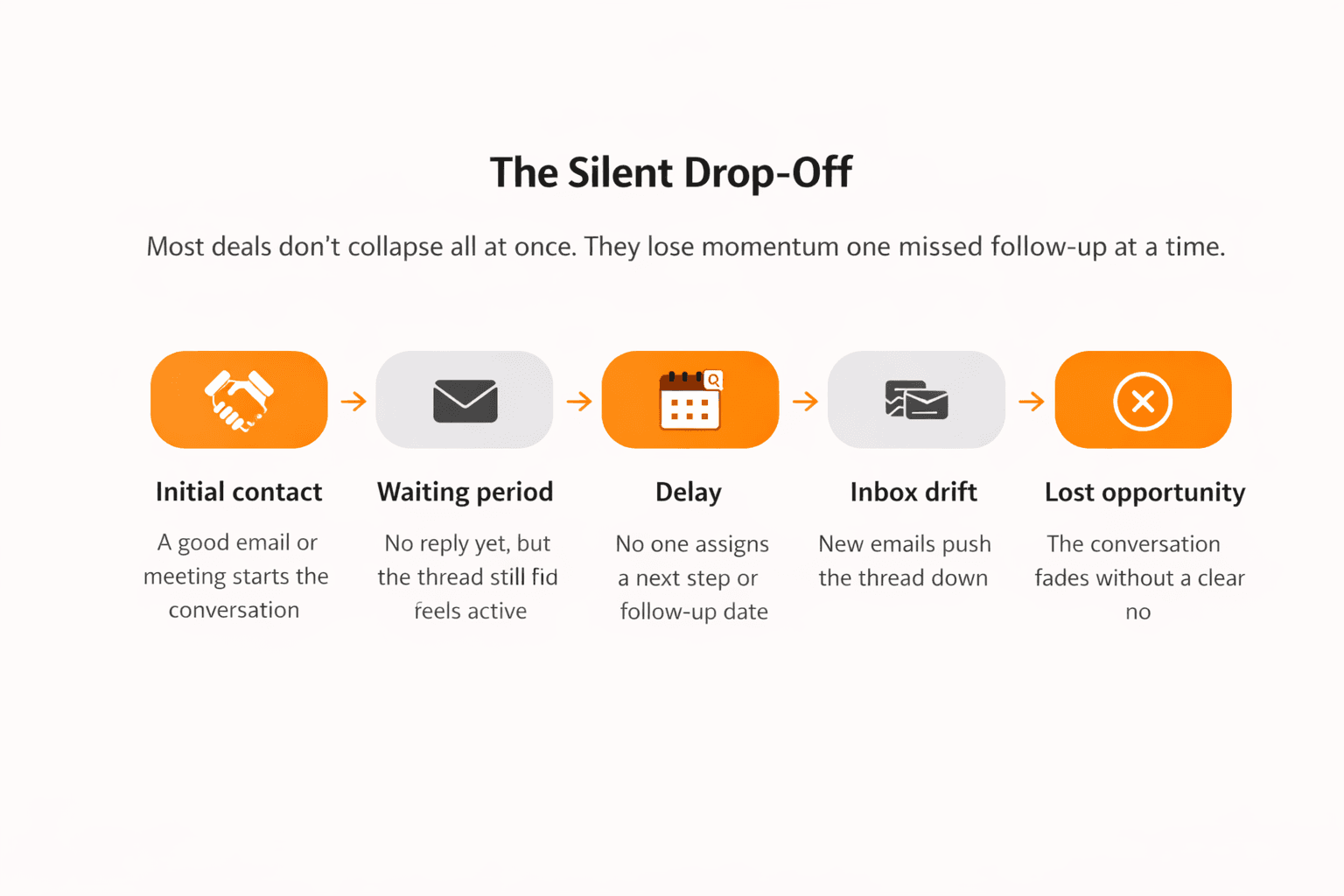
You send an email that matters. Maybe a proposal. Maybe a summary after a call. Maybe a note to a warm lead.
You expect a reply in a day or two. It does not come. But you do not act yet, because the thread still feels recent. Then meetings pile up. Other emails arrive. You open the inbox to handle today’s issues, not last week’s. A few days pass. The thread is still somewhere in the inbox, but now it needs effort to find, re-read, and restart. So it waits.
This is not laziness. It is friction.
And friction compounds.
Woodpecker’s analysis suggests that timing matters a lot: giving prospects at least 2–3 days' notice before the next follow-up is a useful baseline, and 2–3 follow-up emails appear to be the most effective range before returns start to fall off.
Belkin’s 2025 study reached a similar practical conclusion from a different angle: the best average reply rate in its dataset was achieved with one initial email and one follow-up, and by email number three, unsubscribe risk began to rise.
That tells us something simple but important. Follow-up works. But it only works when it is done with timing and discipline.
Most people do not have that discipline built into their email process.
They rely on memory.
And memory is bad at operational work.
Especially inside a crowded inbox.
The hidden cost of “I’ll follow up later.”
“I’ll follow up later” sounds harmless.
It is one of the most common business sentences.
It is also one of the most dangerous.
Because “later” has no owner, no date, and no trigger.
Once a task enters that zone, it depends on recall. And recall is fragile when the workday is fragmented.
Atlassian’s State of Teams 2025 report found that teams and leaders waste 25% of their time just searching for answers.
Even if that figure is broader than email alone, it points to the same operating problem: work gets delayed when information is scattered, and next steps are unclear.
That is why follow-up issues are so common in jobs that run on communication.
Founders deal with partnerships, investors, hires, and customers.
Freelancers deal with leads, revisions, proposals, and unpaid invoices.
Recruiters deal with candidates, hiring managers, scheduling, and feedback loops.
Salespeople deal with multiple prospects across different stages.
Consultants, agency owners, operators, and business development teams all live in some version of the same pattern.
The conversation starts. The next step is implied. But it is not managed.
And then the thread cools down. This is how opportunities disappear without anyone deciding to kill them.
The data says the same thing: persistence changes outcomes
A lot of follow-up advice online sounds repetitive because the same core numbers keep showing up year after year.
That is actually useful.
When the same pattern appears across different datasets, it usually means the signal is real.
Here are a few of the most relevant numbers:
Belkin’s 2025 B2B follow-up study says one initial email plus one follow-up delivered the highest average reply rate in its data, at 8.4%. It also notes that after email number three, unsubscribe risk increases and reply rates weaken.
Woodpecker’s research shows that campaigns without follow-ups average around 9% reply rate, while those with at least one follow-up average around 13%. For experienced users, the gap in its data was even wider.
Outreach says 90% of buyers respond within two days of their most recent message, which is a useful reminder that the “most recent message” matters. If your thread has gone quiet for a week, you are no longer top of mind.
Microsoft says the average worker receives 117 emails daily. That means your email is not competing with just one person’s interest. It is competing with volume.
Put together, these numbers tell a simple story.
People miss follow-ups because inboxes are crowded.
Follow-ups improve reply rates.
Timing matters.
And too many professionals still stop too early.
This does not mean every cold thread can be saved. It does not mean every deal is recoverable. But it does mean many opportunities are being dropped before they are truly dead.
That is a big difference.
The problem is not just sales
A lot of follow-up data comes from sales teams because sales teams measure this stuff closely.
But the pattern extends beyond sales.
Follow-up failure shows up anywhere work depends on reply-driven progress.
Think about how many business outcomes rely on someone answering an email:
A candidate confirming an interview
A prospect responding to a proposal
A client approving a scope change
A founder getting time with an investor
A freelancer nudging an inbound lead
A consultant closing a next-step conversation
A partner confirming an intro or meeting
An accounts team getting paid on time
In all of these cases, the outcome does not depend only on the first email. It depends on what happens after the silence.
That is why poor follow-up is not just a sales efficiency issue. It is an operational issue.
And because it is operational, it often goes unnoticed until someone looks back and realizes how many conversations have stalled.
A story most people will recognize
Here is a simple example.
A consultant speaks to a warm prospect on Tuesday. The call goes well. There is interest. Budget sounds possible. The consultant sends a proposal that afternoon with a short note: “Happy to answer any questions.”
No reply on Wednesday.
No reply on Thursday.
By Friday, the consultant means to check in, but another client issue takes priority. Then Monday starts with meetings. By Tuesday, the thread is a week old and feels awkward to restart. Another few days pass.
At the end of the month, the consultant says the opportunity “went cold.”
Maybe it did.
But maybe it was just unmanaged.
That is the whole point.
A lost deal and an unfollowed deal are not the same thing.
Too many businesses treat them as if they are.
Why do people stop following up too early?
There are a few reasons this happens again and again.
1. They take silence too personally
No reply feels like rejection.
Even when it is not.
People assume they are being ignored, so they hesitate to send another message. But email silence can mean a hundred different things: a busy week, an internal delay, vacation, overload, shifting priorities, a missed email, or simple forgetfulness.
That does not mean endless follow-up is good. It means silence alone is weak evidence.
2. They overestimate how visible their email is
In a normal workday, your message is one line in a crowded inbox. Microsoft’s email volume data makes this obvious.
If the average worker receives 117 emails a day, then even good messages can vanish fast unless something brings them back up.
3. They do not have a timing rule
Without a clear rule, follow-up becomes emotional. One person follows up too quickly, making them feel pushy. Another waits too long and loses momentum. Good systems remove that guesswork.
4. They make the message too hard to write
This one gets ignored. Many professionals delay follow-up because they think each message has to be smart, polished, fresh, and carefully phrased. That creates unnecessary friction.
Short is often better.
Clear is usually enough.
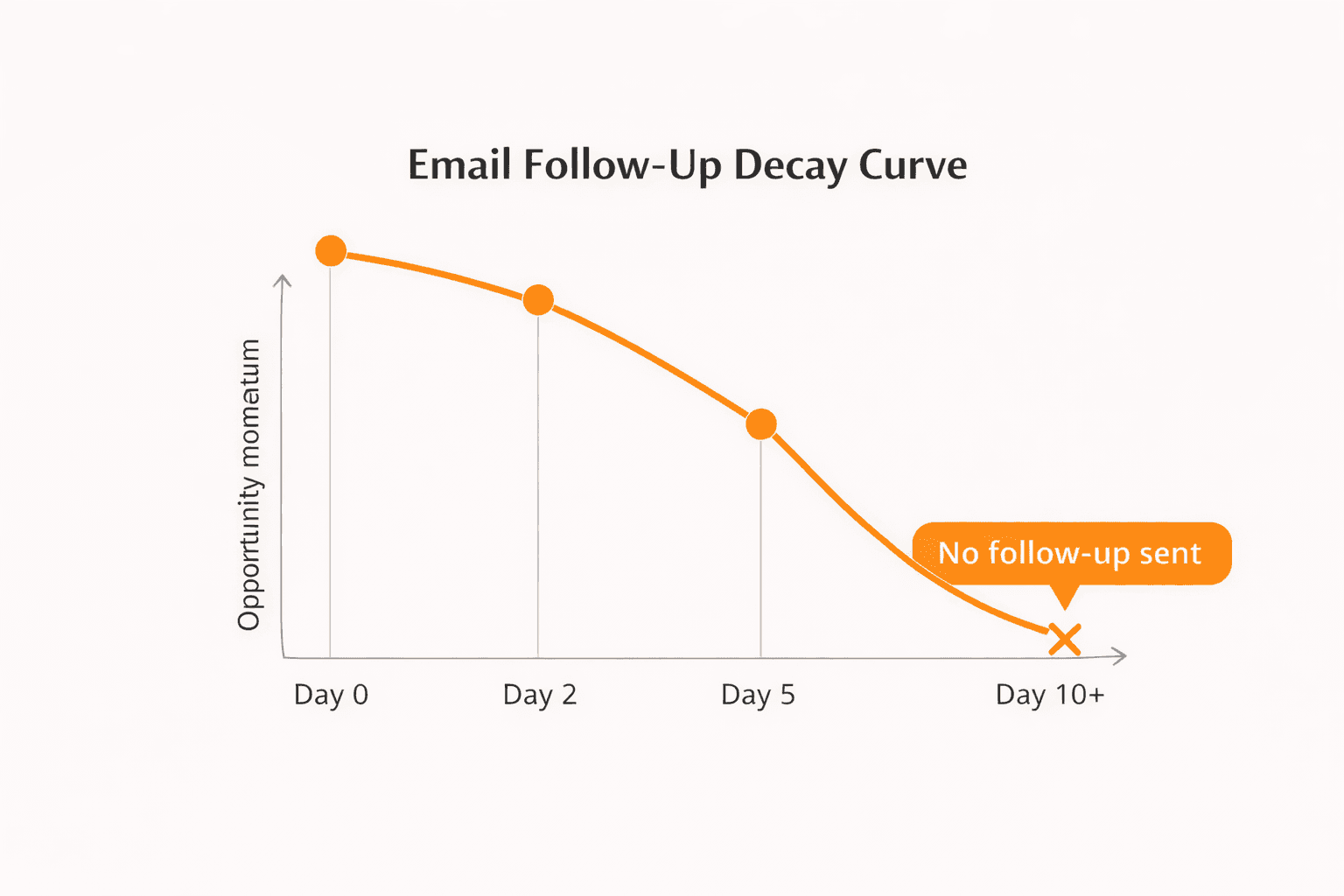
5. They do not distinguish between “still active” and “already fading.”
A thread feels alive longer than it actually is. That illusion costs time. If no one is actively managing the next step, the conversation is already decaying.
What good follow-up looks like in practice
Good follow-up is usually less dramatic than people think.
It is not about pressure.
It is not about sending five long emails.
And it is not about trying to “close” every thread with artificial urgency.
Good follow-up does three simple things:
It brings the conversation back into view
It reduces the effort needed for the other person to respond
It keeps momentum without sounding needy
That can look like this:
“Hi [Name], just checking in on this in case it got buried. Happy to resend the proposal or answer any questions.”
Or this:
“Hi [Name], following up on the note below. Is this still a priority on your side?”
Or this:
“Hi [Name], I wanted to bring this back to the top of your inbox. Let me know if you’d like to keep this moving.”
That is enough most of the time.
You do not need a “perfect” follow-up. You need a sent one.
The real enemy is not silence. It is inconsistency.
Many people read follow-up advice and come away with the wrong lesson.
They think the answer is to become more persistent.
Persistence matters, but it is not the full story.
The bigger issue is inconsistency.
One week, they remember to follow up. The next week, they do not.
One prospect gets two nudges. Another gets none.
One proposal gets revisited. Another just sits there.
That unevenness causes leakage throughout the pipeline.
And it makes the business feel more random than it actually is.
If a team is missing follow-ups in an inconsistent way, then some deals that look “hard to close” are really just “poorly maintained.”
That is an important difference. Because one problem is market reality. The other is the process.
What this means for busy professionals, not just full sales teams
A lot of advice in this space is written for large outbound teams.
That is not useful for everyone.
The founder with 30 active conversations does not want a long playbook.
The freelancer does not want a heavy CRM.
The recruiter does not want a six-step framework for every email.
The consultant does not want another dashboard.
What most busy professionals need is simpler:
a way to know which emails need a follow-up
a clear sense of when to send it
less mental effort when the moment comes
fewer opportunities slipping through because the inbox is messy
That is why light systems beat complex systems for most individuals.
If the system is too heavy, people stop using it.
And then the problem comes back.
A practical audit: how much follow-up leakage do you have?
If you want to see whether this is a real problem in your work, do a quick audit.
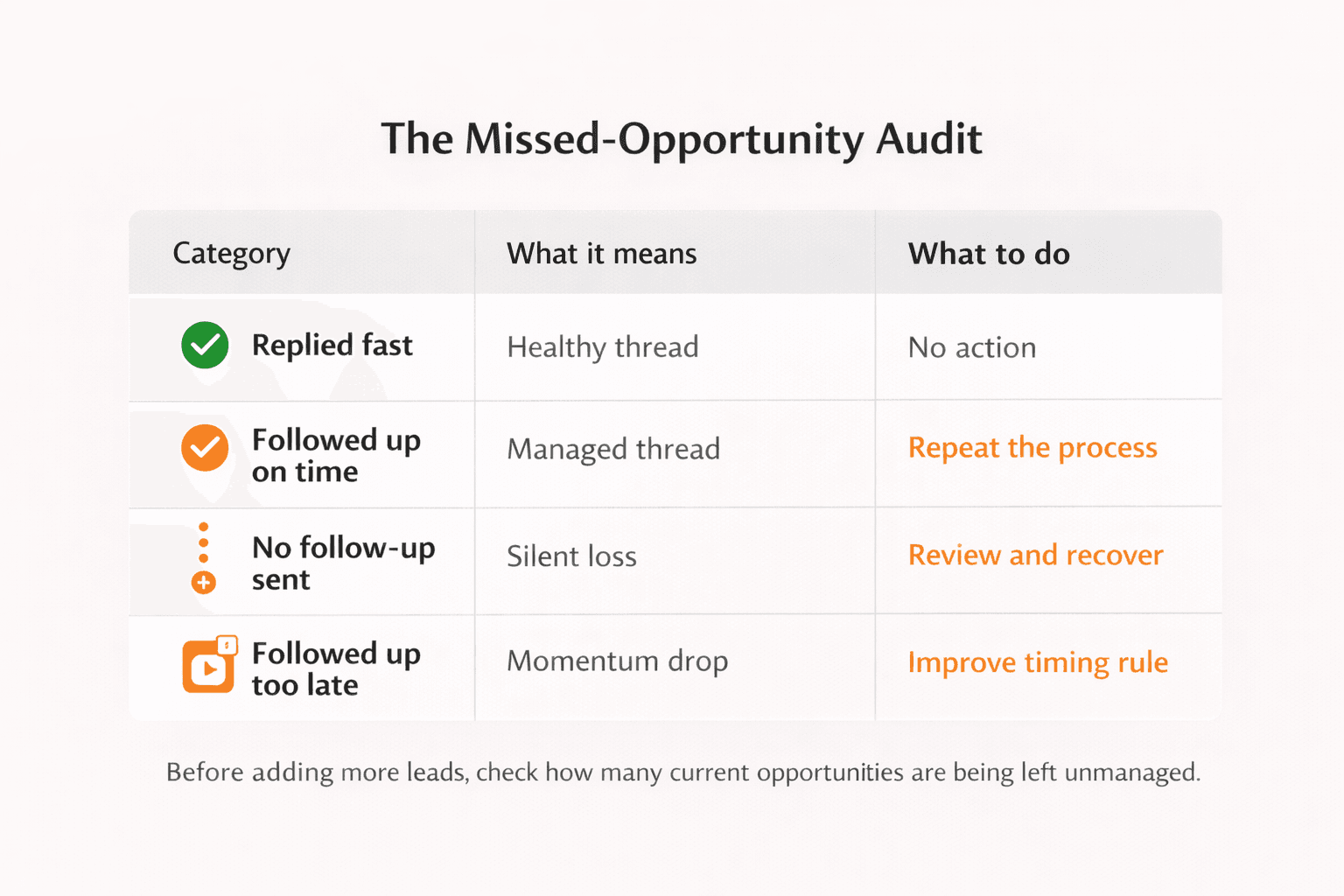
Look at the last 30 important emails you sent.
Then sort them into four buckets:
Bucket 1: Got a reply quickly
These are healthy. Leave them out.
Bucket 2: Needed one follow-up and got one
These are managed.
Bucket 3: Needed a follow-up but never got one
These are silent losses.
Bucket 4: Got a late follow-up after momentum was gone
These are recoverable in theory, but often weaker.
If bucket 3 is larger than you expect, you do not have a lead problem alone.
You have a follow-up problem.
That matters because follow-up problems are often easier to fix than top-of-funnel problems. Getting more leads is expensive. Managing existing conversations better is usually cheaper.
What a strong follow-up culture actually changes
When a person or team gets follow-up right, a few things start to improve at once.
First, reply rates improve. That is the obvious part, and the research supports it. Even one added follow-up can change campaign performance in a measurable way.
Second, pipeline visibility improves. A thread with a clear next step is easier to track than one that is just sitting there.
Third, decision-making improves. When conversations are actively maintained, teams get clearer yes, no, or not-now signals faster. That is better than passive silence.
Fourth, emotional noise goes down. People stop guessing whether they are being ignored and start following a simple process.
And finally, time gets used better. That matters more than ever in an environment where teams already lose significant time to information friction and constant interruptions. Atlassian’s research on time lost searching for answers, and Microsoft’s research on inbox overload, both point to the same root issue: work slows down when systems are weak and context is scattered.
So this is not just about chasing people more often.
It is about reducing wasted motion.
Where manual systems start to fail
Many professionals try to fix this problem manually.
They star emails.
They snooze threads.
They set calendar reminders.
They keep spreadsheet lists.
They leave unread emails as a signal to themselves.
All of that can work for a while.
But manual systems usually fail in the same ways:
They depend on perfect user behavior
They are easy to skip on busy days
They separate follow-up tracking from the actual inbox
They create another place to maintain
That last part matters.
The more places you need to check to manage a single workflow, the more likely it is that something gets missed.
This is why the best follow-up systems usually live close to the inbox itself. Not because people need more software, but because they need fewer disconnected steps.
Where does Recaly fit naturally?
This is also where a product like Recaly makes sense.
Not as a dramatic replacement for how people work.
And not as some oversized sales system for people who just need better follow-through.
The useful role of a tool like Recaly is simpler than that.
It helps turn vague intentions into visible next steps.
It helps surface conversations that need attention.
And it lowers the effort required to act on them.
That matters because most professionals are not failing at follow-up because they do not understand the concept. They are failing because the concept is not embedded in the workflow they use every day.
A tool can help when it removes friction, not when it adds more process.
That is the standard that matters.

The lesson most teams learn too late
Many teams respond to weak conversion by trying to create more demand.
More outreach. More leads. More top-of-funnel volume.
Sometimes that is the right answer.
But sometimes it is the wrong first answer.
If a team is leaking value after the first email, then adding more volume just creates more leakage.
That is like filling a bucket faster when the hole is still there.
The smarter move is often to ask:
Are we following up at all?
Are we following up at the right time?
Are we making it easy for people to respond?
Are we letting too many threads fade without a clear close?
Those questions are less exciting than growth tactics.
But they are often more profitable.
A simple framework to stop losing easy opportunities
You do not need a complicated playbook to improve this.
Start here:
1. Define what counts as an important email
Not every email deserves a follow-up. But proposals, client threads, lead replies, candidate conversations, warm intros, and next-step messages usually do.
2. Decide the timing to send
Do not wait to “remember.” When you send the email, decide when you will follow up if you don't receive a reply.
3. Keep the next message short
A follow-up should be easy to send and easy to answer.
4. Use a small number of follow-ups well
Research suggests one follow-up often adds meaningful value, and 2–3 follow-ups are often a sensible range before returns weaken.
5. Treat silence as uncertainty, not rejection
No reply is weak information. Follow-up is how you get better information.
6. Review sent emails weekly
This catches silent losses before they become old ones.
That alone can tighten a messy pipeline.
If you want to start manually, you can use this approach: The 3-Rule Follow-Up System
Final thought
Most deals do not fail in one clear moment.
They get neglected.
A conversation that could have moved forward gets one email and no system. A warm lead becomes a cold thread because no one brings it back to the top of the inbox. A proposal goes stale because “I’ll follow up later” never became a real task.
That is the real cost of poor email follow-up.
It is not just lower reply rates.
It is a wasted effort.
Wasted conversations.
Wasted opportunities that were closer than they looked.
And the frustrating part is that many of these losses are avoidable.
Not all of them. But more than most teams think.
If your inbox is full, your days are fragmented, and too many promising threads go quiet, do not assume the answer is always more leads.
Sometimes the better answer is better follow-through.
Call to action
If this sounds familiar, do two things this week.
First, audit your last 30 important sent emails and check how many needed a follow-up but never got one.
Second, build a lighter system for the threads that matter.
And if you want help doing that without adding another heavy workflow, keep an eye on Recaly.
It is being built to solve exactly this problem: helping busy professionals catch conversations that shouldn't be lost just because the inbox moved on.